

Rocket Lab
Opening access to space to improve life on Earth
EXIT - Nasdaq: RKLB
Last year’s edition of the DCVC Deep Tech Opportunities Report, released in June 2025, explains the global challenges we see as the most critical and the possible solutions we hope to advance through our investing. This is a condensed and updated version of the first section of Chapter 8.
One of several investments that established DCVC as a leading space systems investor was Rocket Lab. The company went public in 2021 and is making great strides as a provider of small satellite launch services using its Electron rocket and its unique 3D-printed Rutherford engine. The company’s goal is to make space access more affordable, and it has already become the second-busiest U.S.-based launch provider, deploying 204 satellites to low Earth orbit (LEO) in 58 launches. It’s now moving into the medium-lift market with its reusable Neutron rocket, which will see its first test flight this year.
“Since the first U.S. satellite was launched into orbit in 1958, space has been the domain of wealthy governments and multinational contractors that could afford the multi-billion-dollar cost of every mission,” says Matt Ocko, Managing Partner at DCVC. “Rocket Lab changes that math.”
Impulse Space, a more recent investment for us, aims to reduce the costs in a different part of the launch business: moving payloads from LEO to medium Earth orbit (MEO) and geosynchronous orbit (GEO). The company’s Mira spacecraft, which first flew in 2023, is an orbital transfer vehicle that can precisely maneuver payloads of up to 300 kilograms. It’s built for rendezvous and proximity operations, such as the planned refueling of the U.S. Space Force’s Tetra‑5 spacecraft. And its Helios booster, scheduled for its first flight in 2026, is designed to ride a larger rocket such as a SpaceX Falcon 9 to LEO, then rapidly lift 5+ tons of payload to MEO or GEO.
“SpaceX is like a bus that drops you off in LEO, and then Impulse takes you up to your proper orbit, much less expensively than SpaceX can,” explains DCVC operating partner Matt O’Connell. “There’s a lot of business to be done there, including a new generation of communications satellites. And there’s significant government interest in what they’re building. If a government satellite were to stop functioning, being able to get a replacement satellite up quickly and inexpensively has a lot of appeal.” Just as SpaceX has helped the U.S. space business maintain its advantage in low-cost access to LEO, in other words, Impulse Space will give the nation greater flexibility and dominance in medium and high orbits.
Two DCVC-backed Earth observation companies continue to demonstrate why commercial access to space is so important. Capella Space owns a constellation of synthetic-aperture radar (SAR) satellites that can see the surface at night and through clouds, at very high resolution and with frequent repeat visits. That combination of capabilities is useful to the U.S. government, which relied on Capella’s images to predict the Russian invasion of Ukraine. Capella announced in May that it had won a contract to develop new SAR image acquisition modes to support the DoD’s Hybrid Space Architecture, which is designed to provide secure communications for military operations. That same month, quantum computing leader IonQ [NASDAQ: IONQ], which is establishing a space-to-space and space-to-ground quantum internet, announced that it had acquired the company.
Similarly, Planet’s Dove, SkySat, and next-generation Pelican constellations are built to gather medium- and high-resolution optical images of every spot on Earth’s landmass, helping with environmental monitoring, security, and intelligence gathering. While the company has long focused on data services, it’s also begun to build dedicated Pelican satellite constellations for specific customers, including one that recently signed a seven-year, $230 million contract, Planet’s biggest ever. (Both Capella and Planet have partnered with Rocket Lab to deploy their constellations.)
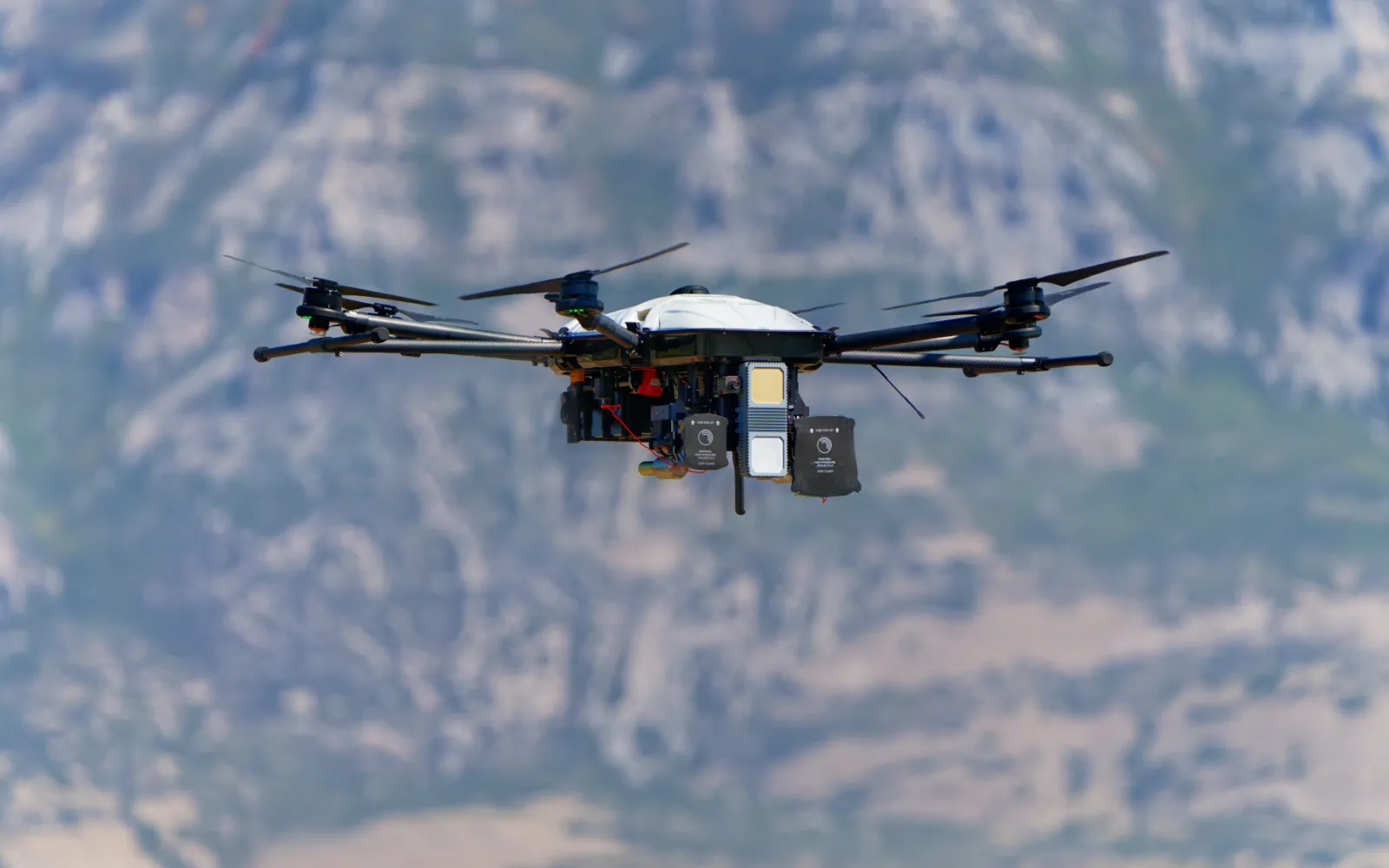
Closer to the planet’s surface, Fortem Technologies has been showing how venture-backed companies can help against the growing threat of unmanned aerial systems, or UAS. Whether in the form of store-bought, rotor-driven drones or fixed-wing reconnaissance or munitions drones, these systems are considered by the DoD to be “an inexpensive, accessible, flexible, expendable, and plausibly deniable way to carry out armed attacks and project outsized power.” Fortem’s DroneHunter F700 interceptor is designed to counter all types of UAS with measures such as tether nets or parachute nets. It’s been used in Ukraine to detect and capture Iranian Shahed-136 “kamikaze” drones deployed by Russia. With the aid of Fortem’s real-time risk assessment software, it can also be used to secure the airspace around sports stadiums and other event venues.
To protect itself against peer, near-peer, and asymmetric adversaries, the nation needs radically new ideas like these — and many of them are bubbling up at small companies.
Opening access to space to improve life on Earth
Opening access to space beyond Low Earth Orbit
Any time, any weather Earth observation for commerce, conservation, and security
Providing daily data and insights about Earth
Building systems to counter drones and keep people and infrastructure safe