

Mythic
Power-efficient AI hardware for distributed devices
The AI race won’t be won by the country that can build the most data centers fastest. It will be won by whoever escapes the power trap of today’s brute-force AI architectures first, from enabling mission-critical drones that need to triple their run-time while still running AI, to enabling datacenters that can be built in hot climates without melting down.
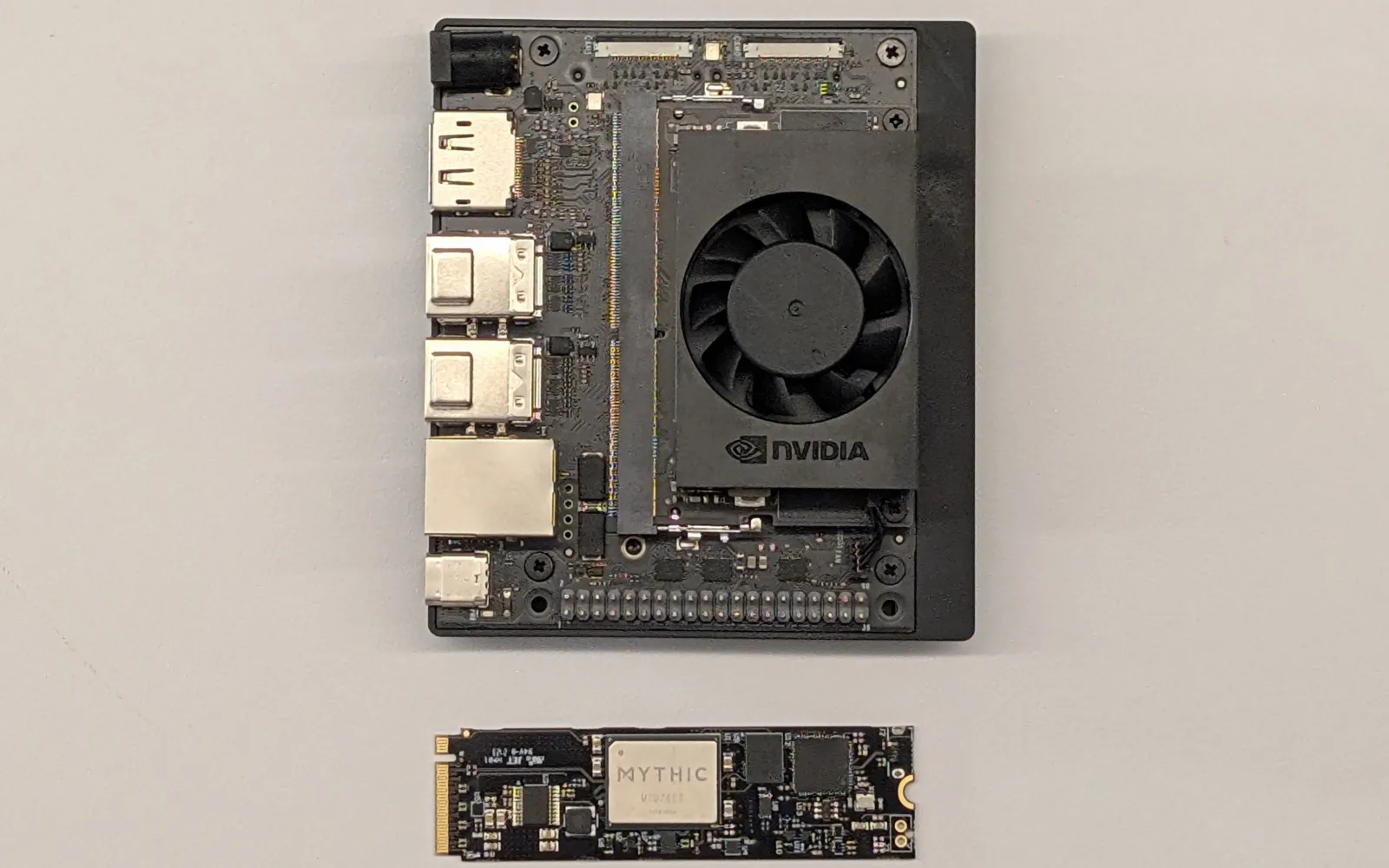
Today, Mythic announced a DCVC-led $125 million oversubscribed funding round (see Bloomberg coverage here) to scale the technology that can get America there: an analog compute architecture 100x more energy-efficient than the GPUs we’re all dependent on today, that scales from the smallest life-critical military systems to the biggest data centers, and runs key AI models off the shelf. In addition to having a power advantage, Mythic chips are, compared to all other alternatives, many times smaller and lighter, and much lower cost to produce and operate — and are manufacturable on American and allied semiconductor fabs.
For years, AI progress has been framed as a problem of scaling models and data, with compute assumed to be an endlessly expandable input. But AI’s defining constraint turns out to be power: as workloads scale, modern AI systems are colliding with the enormous energy cost of moving data back and forth inside today’s dominant chip architectures.
Graphics processing units (GPUs) fueled the rise of modern AI, but they are built on a von Neumann chip design first conceived in the 1940s, in which memory and compute are physically separate. This divide forces chips to shuttle data back and forth constantly, burning 90% of the energy used in AI on movement rather than compute.
The math is brutal: it’s projected that by the end of the decade, one-tenth of the electricity produced by the U.S. power grid will be consumed by data centers running AI workloads. Similarly, you can’t build AI systems for defense like drones, with the power requirement and cooling system weight of a small toaster, with current architectures. The only way out is a different chip architecture, and that’s what Mythic has created.
DCVC first invested in Mythic in 2016 because the company was pursuing analog compute-in-memory, in which computation and memory are collapsed into a single plane, much as with the human brain. Instead of fighting physics, Mythic works with it – performing the most energy-intensive AI operations directly in analog and eliminating orders of magnitude of wasted power.
Mythic’s promised benefits are no longer theoretical. As today’s announcement shows, the company’s Analog Processing Units deliver up to 120 trillion operations per second per watt — roughly 100x the energy efficiency of top-of-the-line GPUs when memory transfers are included — while maintaining accuracy and dramatically lowering cost and latency.
These are measured performance metrics, validated in production silicon and by demanding customers across defense, automotive, and robotics, using both proprietary and open-source, “off the shelf” models. Mythic’s comprehensive advantage is not just its energy efficiency, but its transparency with existing software, the result of a decade of work that would-be competitors are just beginning to struggle with.
None of this happened by accident. Under CEO Taner Ozcelik’s leadership, Mythic underwent a ruthless refinement and commercialization focus for its architecture, roadmap, software, and execution discipline. Taner, who founded and led Nvidia’s automotive business, brought not only deep technical credibility but also the clarity and rigor required to vet and validate from first principles and turn a hard idea into a scalable platform. This new direction convinced a consortium of investors, including strategic partners like Honda Motors and Lockheed Martin, to join this oversubscribed round.
The stakes could not be higher as AI moves out of hyperscale data centers and out to the edge: real-world environments like vehicles, sensors, autonomous systems, and critical infrastructure. That future is impossible if every advance requires exponentially more electricity. Energy-efficient inference is not a “nice to have.” It’s the prerequisite for scale, resilience, and national security.
Mythic’s analog architecture is the kind of breakthrough that wins technology races: not more resources, but smarter, more elegant engineering. It gives America and its allies an edge that no amount of electricity can buy.