Winning the quantum race: America’s blueprint for dominating the next tech revolution

The United States has long been the cradle of quantum innovation. American laboratories birthed the first superconducting qubits and gave us Shor’s algorithm. Yet the history of other transformational computing technologies has raised a troubling question: Will the U.S. merely invent the quantum era, or will we actually manufacture it? The fear of eventually licensing our own breakthroughs back from overseas — and all the national security vulnerabilities that would be coming along for the ride — has been a lingering concern.
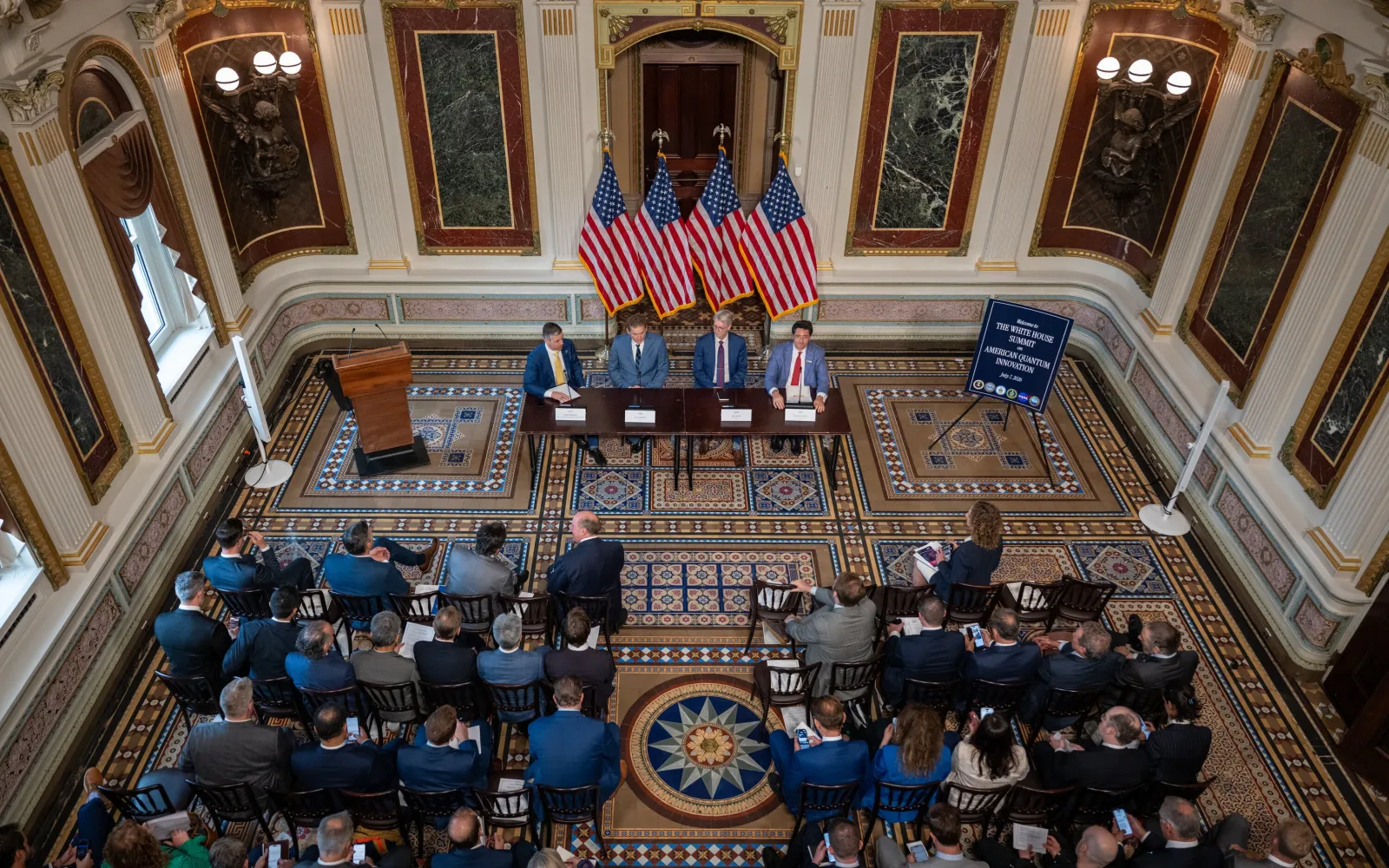
I’m thrilled to say that it’s now being squarely addressed. On July 7, the White House hosted a summit of senior government officials and leaders from nearly every major U.S. quantum company to discuss the specifics around how to ensure American leadership in quantum. DCVC Co-Founder and Managing Partner Matt Ocko and I were glad to have been invited, and to continue conversations we’ve been having across industry and government for years. The summit closely followed President Trump’s signing of two executive orders that fundamentally transform America’s approach to quantum technology, shifting the focus from pure research to aggressive industrial strategy.
The first order, “Ushering in the Next Frontier of Quantum Innovation,” is about playing offense in the contest for global market dominance. It sets the stage for building a massive, catalyzing quantum computer at a Department of Energy facility. Just as importantly, it activates crucial commercial levers. The order tasks the Department of Commerce with exploring advance market commitments to support domestic quantum foundries. This mirrors the government’s historical role as a guaranteed early buyer, much like the defense and space contracts that initially fueled the silicon industry. Commerce is already laying the groundwork; in May, it acquired non-controlling minority stakes in nine quantum companies (including $100 million stakes in two companies DCVC has backed, Atom Computing and Rigetti, and the material involvement of two other DCVC portfolio companies, Quantum Motion and IonQ) through a $2 billion investment.
This strategy is critical to avoiding past missteps. America invented the transistor but ultimately watched semiconductor manufacturing shift to Asia, losing control over this strategically critical supply chain. To prevent the third wave of compute from suffering the same fate, the administration is using government backing to de-risk the market, giving private capital the clear demand signal it needs to get over procurement and supply-chain hurdles. Going deeper, the order acknowledges that technological supremacy requires a coalition. By aligning export controls and investment screening with allies — building on frameworks like Pax Silica and the recent UK Prosperity Deal — the U.S. aims to keep talent and capital flowing freely while walling off critical supply chains from adversaries.
The second order, “Securing the Nation Against Advanced Cryptographic Attacks,” operates as America’s defensive shield. Hostile actors are actively employing a “harvest now, decrypt later” strategy, quietly siphoning encrypted data today in anticipation of future quantum computers that will be able to break it. In response, the Office of Management and Budget and the National Cyber Director are mandating that crucial federal systems migrate to NIST’s new post-quantum cryptography standards. With strict deadlines set for the end of 2030 and 2031, this directive leverages federal procurement rules to get government contractors and private companies to fortify their digital vaults with the urgency the threat demands.
Successfully executing this ambitious vision will depend on four essential pillars: patient capital willing to weather the gap between prototype and deployment; robust domestic manufacturing; a unified international coalition of allies; and an agile workforce trained through months-long apprenticeships and credential pathways, not just years-long doctoral programs.
Ultimately, the two orders signal that the American quantum sector is officially open for high-scale business and Western alliance dominance, and the timing couldn’t be more propitious. The pace of technological breakthroughs is accelerating. The policy framework is finally in place. Now, the heavy lifting of building the domestic quantum industry begins.
For more, check out my op-ed in the Financial Times.