
Quantum Motion
Fast-tracking the development of fault-tolerant quantum computer systems
Quantum computing has been the subject of breathtaking demonstrations and breathtaking hype. But demonstrations don’t become successful companies on their own. At DCVC, we’re experienced in investing across the quantum stack. That experience has taught us to focus on which platform can be manufactured. The winning architectures will be the ones that can be industrialized — not just demonstrated.
That conviction is why we are thrilled to announce that DCVC is leading Quantum Motion’s $160M Series C alongside Kembara. This isn’t just an investment in a yet-another quantum company. It is a bet on industrialization, on the thesis that the next generation of transformative computing infrastructure will be manufactured on the same foundation that supported the last one: silicon.
The semiconductor leverage
The global semiconductor fabrication ecosystem represents one of humanity’s greatest concentrations of industrial capability: hundreds of billions in installed capital, thousands of optimized processes, and decades of hard-won yield-improvement know-how. Any quantum hardware company that can tap into this infrastructure doesn’t need to rebuild from scratch. It inherits a head start.
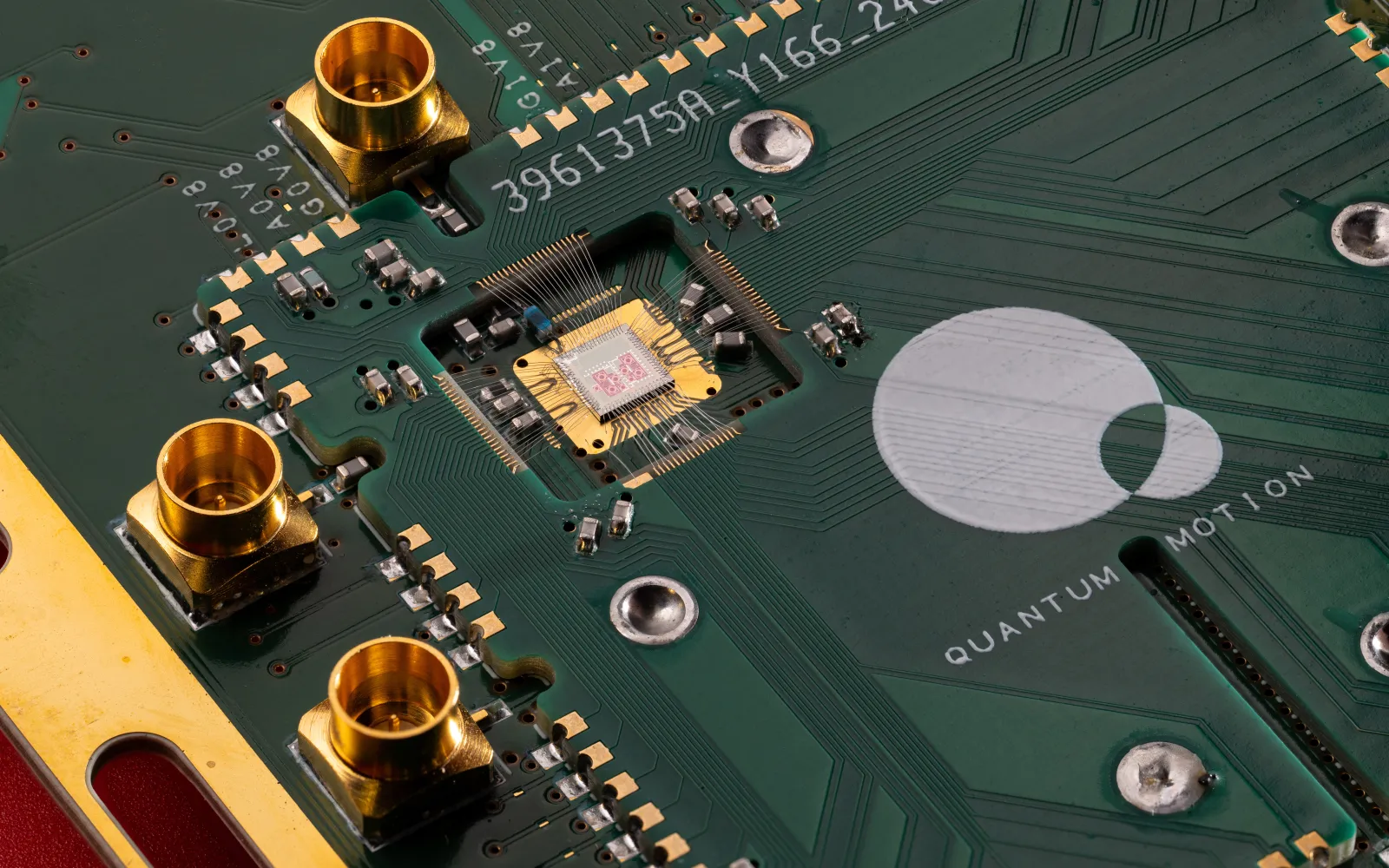
This is the core of the silicon-spin qubit platform. Quantum Motion’s qubits are formed by individual electrons trapped in gate-defined quantum dots, with quantum information encoded in the electrons’ spin states. These structures are patterned lithographically in standard CMOS foundry processes — the same process control, yield optimization, and defect management that underpin the classical semiconductor industry. The manufacturing overlap is not incidental. It is the strategy.
The density advantage is similarly staggering: each physical qubit occupies less than 0.04 µm², enabling qubit densities exceeding one million per square millimeter. All four million physical qubits in Quantum Motion’s target architecture fit within roughly one square millimeter of a single centimeter-scale chip — with room to grow.
Architecture built to scale
Quantum Motion has made a series of architectural choices that distinguish its approach from the canonical playbook. Rather than dense two-dimensional arrays with fixed nearest-neighbor coupling — the standard surface code approach — they have developed and patented architectures based on mobile qubits and shared control.
The system is built on bilinear arrays of exchange-coupled quantum dots enabling efficient fan-out, control, and measurement. Electrons can be physically shuttled between sites, bringing qubits into proximity for two-qubit operations without requiring long-range couplers or dense interconnects. Many qubits share common control lines with local tuning for parameter matching, which dramatically reduces wiring complexity — avoiding the interconnect explosion that threatens to cap other platforms well short of the million-qubit mark.
These bilinear arrays are connected through controllable couplers into looped-pipeline architectures that enable three-dimensional logical connectivity in a physically two-dimensional device. The result is a compact, fault-tolerant layout that can sustain up to 3,400 logical qubits in a single circuit at a logical error rate of 10⁻¹².
A critical advantage underpins all of this: Quantum Motion’s platform integrates cryo-CMOS control electronics directly alongside the qubits, at scale. Quantum Motion designs these cryo-CMOS chips in-house and fabricates them on GlobalFoundries’ process, placing high-speed DACs, low-noise amplifiers, and multiplexing networks at cryogenic stages close to the qubit plane. This reduces signal latency, improves fidelity, and cuts the cabling that would otherwise make million-qubit systems physically unmanageable.
The road to fault tolerance
The quantum industry is transitioning from Noisy Intermediate-Scale Quantum (NISQ) processors toward fault-tolerant quantum computing (FTQC). DARPA’s Quantum Benchmarking Initiative — among the most rigorous external evaluations of quantum hardware anywhere in the world — has advanced Quantum Motion to Stage B, where the path to commercial utility is tested under real-world conditions. Silicon spin has become the most represented qubit modality in the QBI pipeline. That is not an accident. It reflects a growing recognition across the community that manufacturability is inseparable from the path to fault tolerance.
In 2025, Quantum Motion delivered the world’s first full-stack silicon CMOS quantum computer to the U.K. National Quantum Computing Centre — a system housed in three server racks, occupying roughly 15 square meters. This is a quantum system that fits into the footprint of a modern data center. Single-qubit gate fidelities already exceed 99%, gate yields top 99.3%, and the system is designed to tolerate the hard defect rates inherent in any real manufacturing process.
The Series C funds the next milestones on this trajectory: scaling from unit-cell demonstrators to systems of increasing complexity, with a 1,000-qubit looped-pipeline system demonstrating fault tolerance — and a clear roadmap to a one-million-data-qubit machine.
Manufacturing, reindustrialization, and the quantum supply chain
There is a broader context to this investment that extends beyond any single company’s roadmap. We are in the early innings of a global reindustrialization — a period in which the nations and companies that control advanced manufacturing capacity will define the next century of economic and security leadership. Semiconductors sit at the center of that contest. Quantum hardware, which depends on fabrication tooling, cryogenic packaging, materials science, and the supplier networks that surround them, is inseparable from it.
Quantum Motion’s approach doesn’t just benefit from this reality — it is built on it, bridging the U.K.’s world-class quantum science with the global CMOS supply chain through foundry partnerships with GlobalFoundries and Imec. Recently announced initiatives from the U.S. Department of Commerce reflect the same insight: semiconductor and quantum share an industrial base.
Our investment in Quantum Motion is not an isolated bet. It is another pillar of a broader strategy to back nationally critical quantum infrastructure — informed by what we believe is the deepest quantum portfolio in venture capital.
We have been the anchor investor from seed to IPO for several of the world’s most important quantum companies: Atom Computing, Q‑CTRL, Horizon Quantum, Capella Space (now within IonQ), Iceberg Quantum, Logiqal, Mesa Quantum, and others we are enthusiastic to announce soon. That experience gives us a clear view of what separates demonstration from deployment. Quantum Motion represents convergence: scalable qubit design, an architecture engineered for manufacturability, and a production base that leverages the silicon fab ecosystem. The company is ensuring that fault-tolerant quantum computing isn’t waiting for some future breakthrough. It’s being manufactured today.