
THE GLOBAL ECONOMY is like an evershifting weather system affected by short-term storms, seasonal El Niñolike patterns, and long-term weather and climate trends. And like good meteorologists, we constantly monitor the financial, market, and regulatory conditions creating tailwinds or headwinds for our portfolio companies.
As always, we’d like to open the Deep Tech Opportunities Report with a data-driven survey of some of the weather we’re tracking. Our observations this year center on the reopening of the IPO window, the growing likelihood of large liquidity events in AI and space, the continued scramble to lower the cost of computation and energy for an AI-heavy economy, and the rising strategic pressure to rebuild supply chains closer to home.
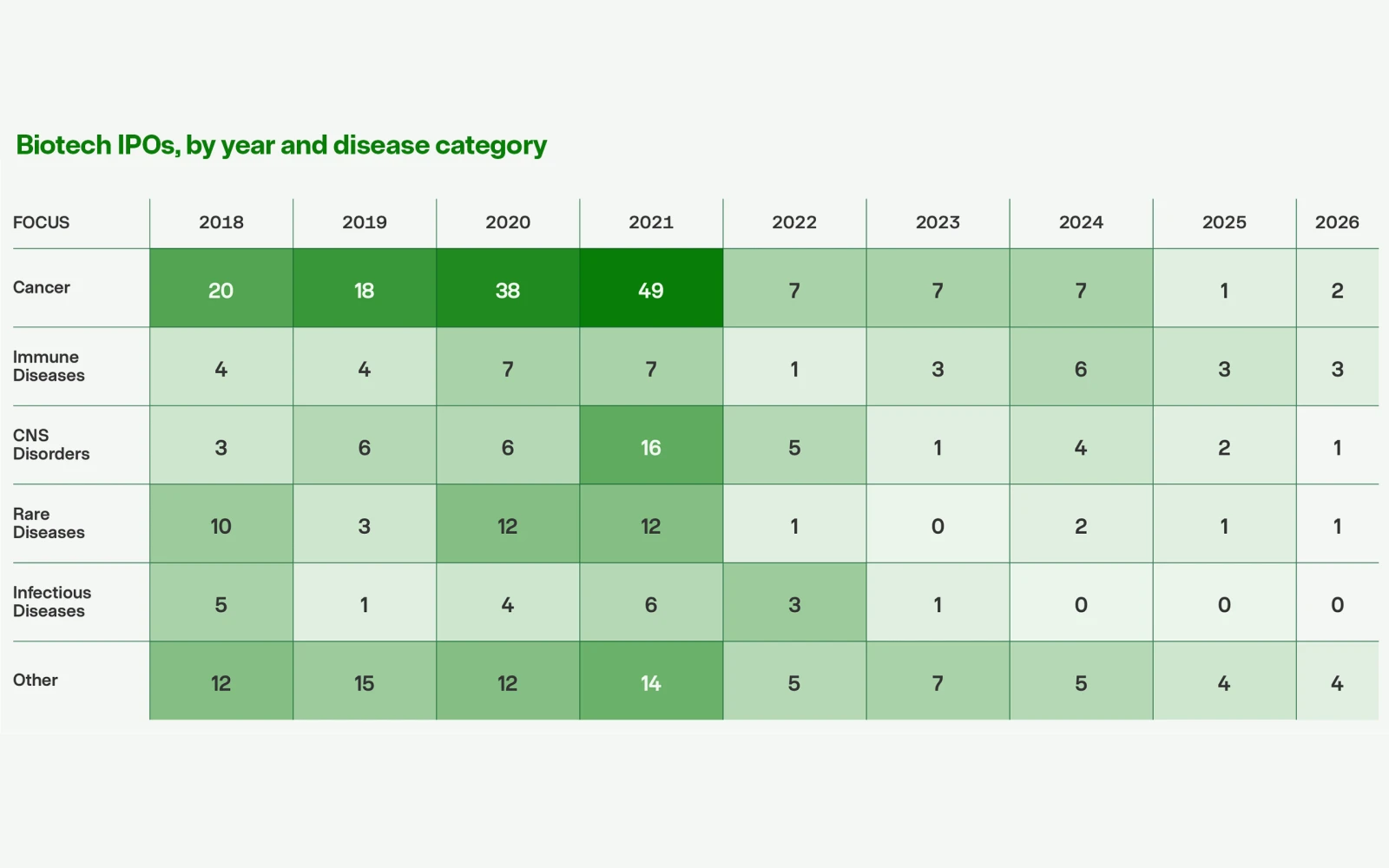
Biotech’s IPO window has begun to reopen.
Historically, 35 to 45 biotech companies went public each year. But a multiyear post-pandemic IPO drought dragged into 2025, when there were only nine meaningful biotech IPOs (“meaningful” in the sense that the offerings raised at least $75 million). In the second quarter of 2025 — for the first time in a decade — there were no biotech IPOs at all, due in part to higher interest rates, regulatory uncertainty, and budget uncertainty at the Food and Drug Administration and related government agencies. But the market began to thaw in the fourth quarter, and in the first quarter of 2026, we saw half a dozen meaningful biotech IPOs, including for Aktis, Veradermics, Eikon, Spyglass, Agomab, and Generate. In February alone, companies raised $1.4 billion — a sign that generalist investors are coming back into the market. Barring a major macroeconomic shock, the market could produce 25 to 30 IPOs in 2026. The upshot is that venture investors in biotech can begin to cash out their positions in this generation of biopharma companies and return funds to their LPs, allowing the innovation cycle to continue.
The prospect of mega-IPOs in AI and space could reset venture liquidity for years.
In May SpaceX filed the prospectus for its initial public offering, targeting a valuation of $1.75 trillion. As this report went to press (on May 22), Open AI was not far behind SpaceX, and was reported to be preparing to file confidentially for an IPO within weeks. The LLM maker was valued at $730 billion in its most recent private funding round. And Anthropic is on a similar trajectory; its most recent financing valued the company at $900 billion, with revenue doubling to $10.9 billion in the second quarter, according to reports in the Wall Street Journal. Even the credible prospect of IPOs on this scale is already reshaping the venture environment, as private-market valuations get marked up in anticipation of future liquidity. Such listings could release enormous amounts of venture LP capital for new investments; leave all three companies in better position to acquire newer, smaller firms; and free up talent to found the next generation of AI and space companies. But they could also suck up public capital and temporarily suppress the market for other tech IPOs. We’ll be watching all of these developments closely. And we’re also monitoring a tide of energy-company IPOs that could lift many boats in the industries devoted to building physical things.
As AI shows up in more applications across the business world, there’s a looming cost-structure problem.
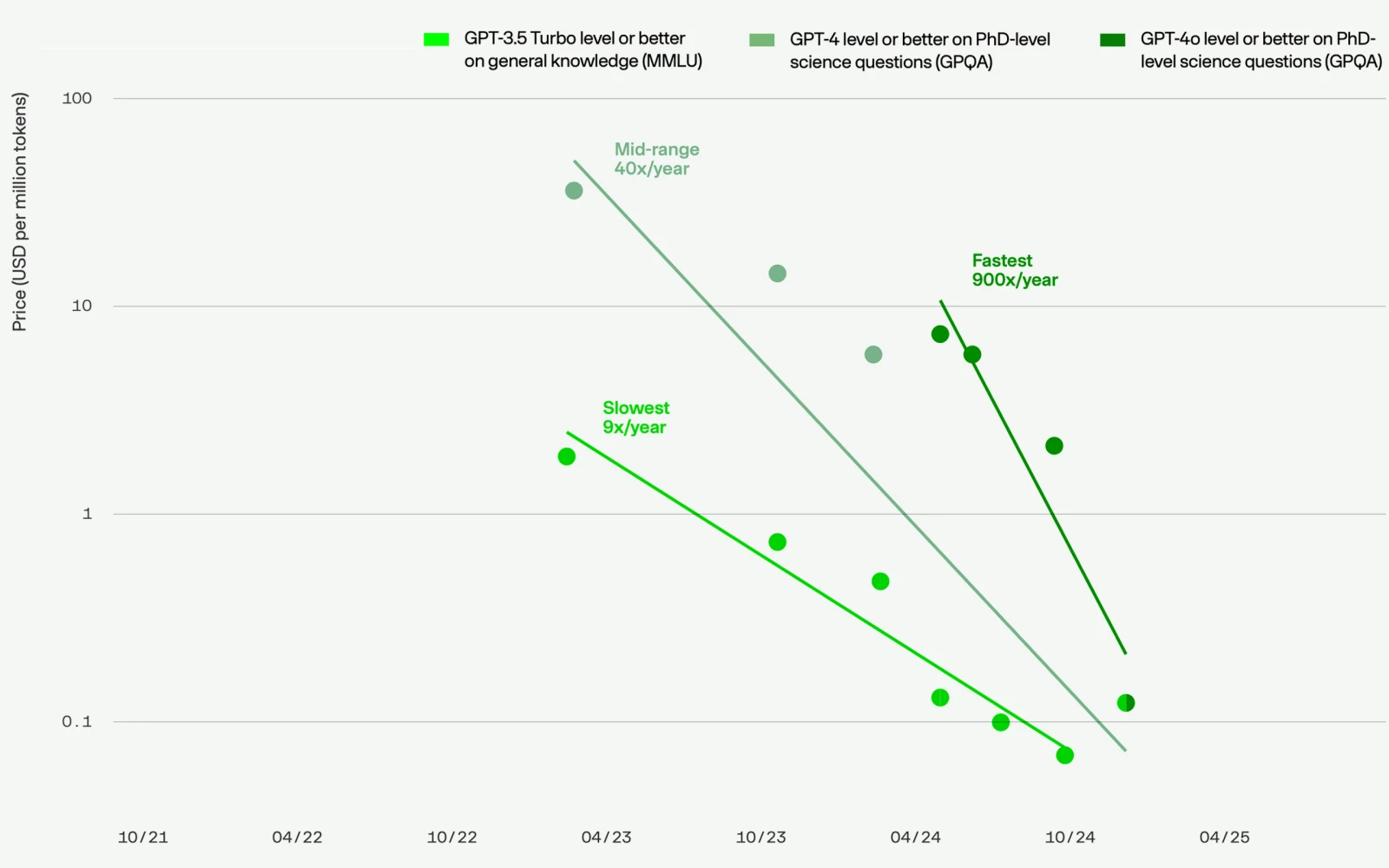
The cost of inference from frontier AI models is falling rapidly (see Figure 0.1.2) thanks to model improvements, hardware advances, and other techniques — but not fast enough to offset exploding inference demand as AI gets integrated into more products. For application-layer companies whose primary expense is model inference — think coding assistants like Cursor, search engines like Perplexity, or productivity tools like Grammarly — this widening gap will squeeze margins and create significant headwinds. But it is also creating powerful tailwinds and investment opportunities where companies are developing more efficient models and compute infrastructure that can reduce the cost of inference by orders of magnitude. For more, see Opportunity 1.2 and Opportunity 1.3.
The age of monolithic AI architectures is already giving way to something more complex.
The early generative AI boom (roughly 2020 to 2022) was driven by a simple hypothesis: make one model large enough, train it on enough data, build a data center with enough standardized chips to run it, and it will be able to perform almost every cognitive task. This made system design relatively straightforward. The problem, as we just noted, is that frontier models are extremely expensive to run. In practice, most tasks do not require a frontier model at all. A more efficient architecture is beginning to emerge — one that distributes work across multiple agents, multiple models, and multiple types of hardware. Powerful GPUs may handle large reasoning tasks, while smaller models run on cheaper inference chips, edge accelerators handle real-time loads, and old-fashioned CPUs coordinate all of their workflows. This shift is creating a market for a new class of heterogeneous compute companies building model-routing platforms, AI orchestration frameworks, composable multi-model agents, and cross-chip scheduling software to determine which model is best suited to the job, where it runs, and how tasks are distributed. As Adam Smith observed in The Wealth of Nations 250 years ago, productivity tends to increase when tasks become specialized. AI systems appear to be evolving in the same direction. (Again, see Opportunities 1.2 and 1.3.)
Global decoupling means that supply chains are gradually being restructured along geopolitical lines.
For decades, venture capital mostly ignored industrial sectors, because everyone assumed globalization had already optimized them for cost efficiency and scale. But the pandemic, rising U.S.-China strategic competition, and national security concerns around critical technologies and materials have revealed intolerable imbalances and choke points in global production and distribution networks. As a result, each year the U.S. is now spending hundreds of billions of dollars rebuilding industrial capacity and adding hundreds of thousands of manufacturing jobs through reshoring and foreign direct investment. (Manufacturing construction spending has more than doubled since 2021, driven largely by semiconductor, battery, and clean-energy factories.) Because labor costs are higher in the U.S., smart reshoring requires AI-driven quality control, robotics, and other forms of automation and advanced manufacturing. It also means developing alternative material supply chains for rare earth elements, batteries, and semiconductors, as well as large amounts of firm baseload power. All of this is stimulating a wave of investment in the deep tech innovations required to manufacture goods, process materials, and produce energy closer to home. (We talked about all these trends at length in the 2025 Deep Tech Opportunities Report; see also Chapters 3 and 4 of this volume.)
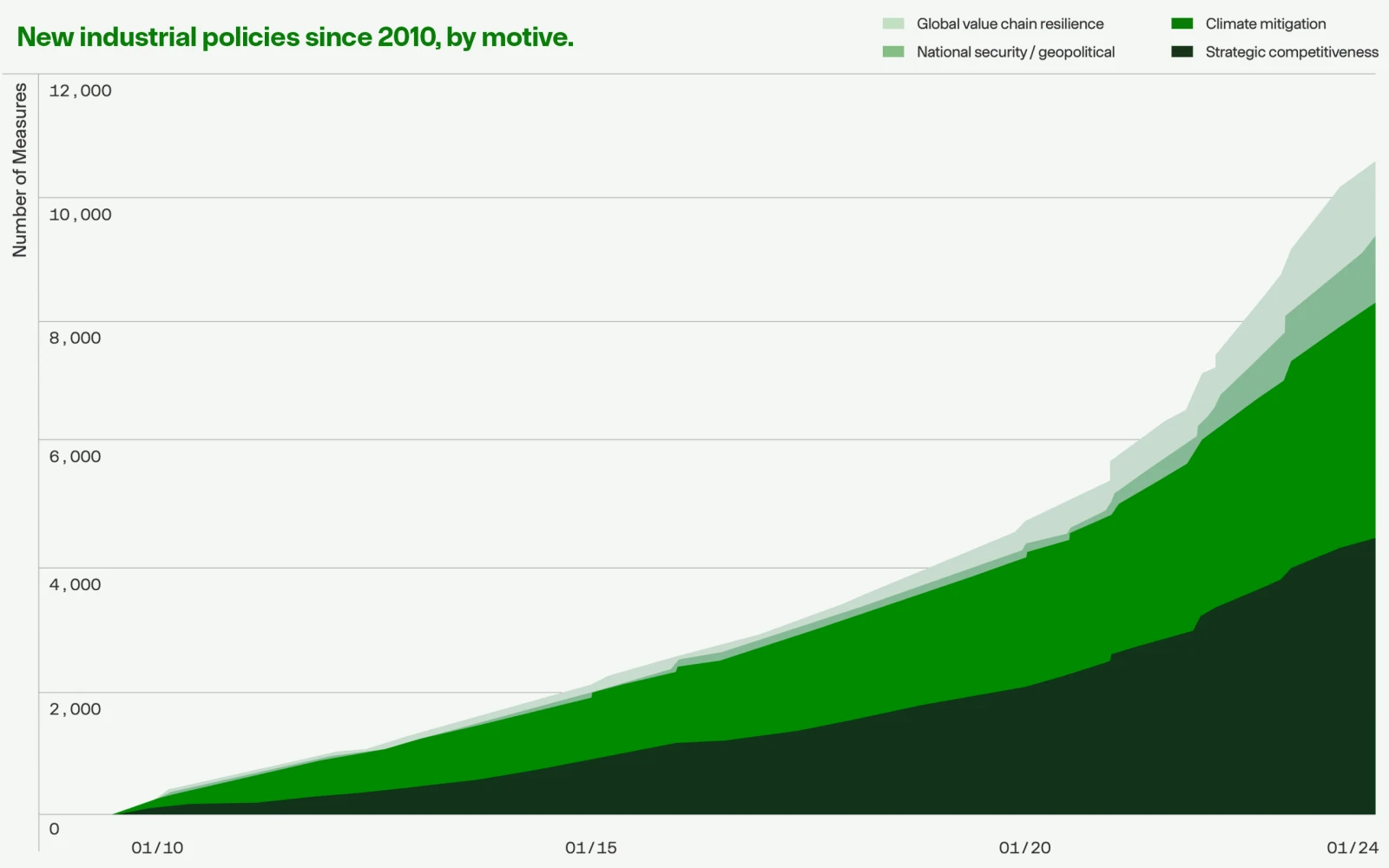
Industrial policy is returning worldwide, although in many different forms.
After decades in which governments largely relied on markets to allocate industrial investment, major economies are now actively subsidizing strategic sectors such as semiconductors, batteries, energy, and critical minerals. The IMF observes that new industrial subsidies shot upward globally after 2020, in response to the same concerns over supply chain resilience, national security, and geopolitical competition we just mentioned. In the United States, this takes the form of a patchwork of federal and state programs rather than a single national industrial strategy. Many of the programs launched during the previous administration — notably the CHIPS and Science Act, the Inflation Reduction Act, and Department of Energy (DOE) loan programs — remain in place even as they’re being reinterpreted, renegotiated, or partially scaled back. Meanwhile, states have instituted big incentive packages to attract industrial projects, including New York’s $10 billion Green CHIPS program, incentives in Georgia for EV and battery factories, and incentives in Arizona for semiconductor fabs. And these incentives are working: In 2025 companies invested $278 billion in the manufacture and deployment of clean energy, clean vehicles, building electrification, and carbon management technology, up 5 percent from 2024, according to MIT and Rhodium Group. That investment wave inevitably expands the market for deep tech companies in advanced manufacturing, materials, and energy.
Deep tech entrepreneurs play a stabilizing role in an unstable and rapidly changing world where the economic weather seems increasingly stormy. Rather than fixating on lofty dreams about techno-utopian futures, they roll up their sleeves and ask the practical questions: How’s it going to work? and Who’s going to pay for it? Our team of investors is hyperfocused on finding and funding the best of these innovators, and it’s our continuing privilege to help them do their work.”
Zachary Bogue and Matt Ocko
Co-Founders and Managing Partners, DCVC