
The real economy of 2026 — the environment where all entrepreneurs, innovators, and investors must function — is marked by persistent unpredictability. Thanks to a handful of compounding forces operating at national and planetary scale, it’s becoming harder to plan for growth, not easier:
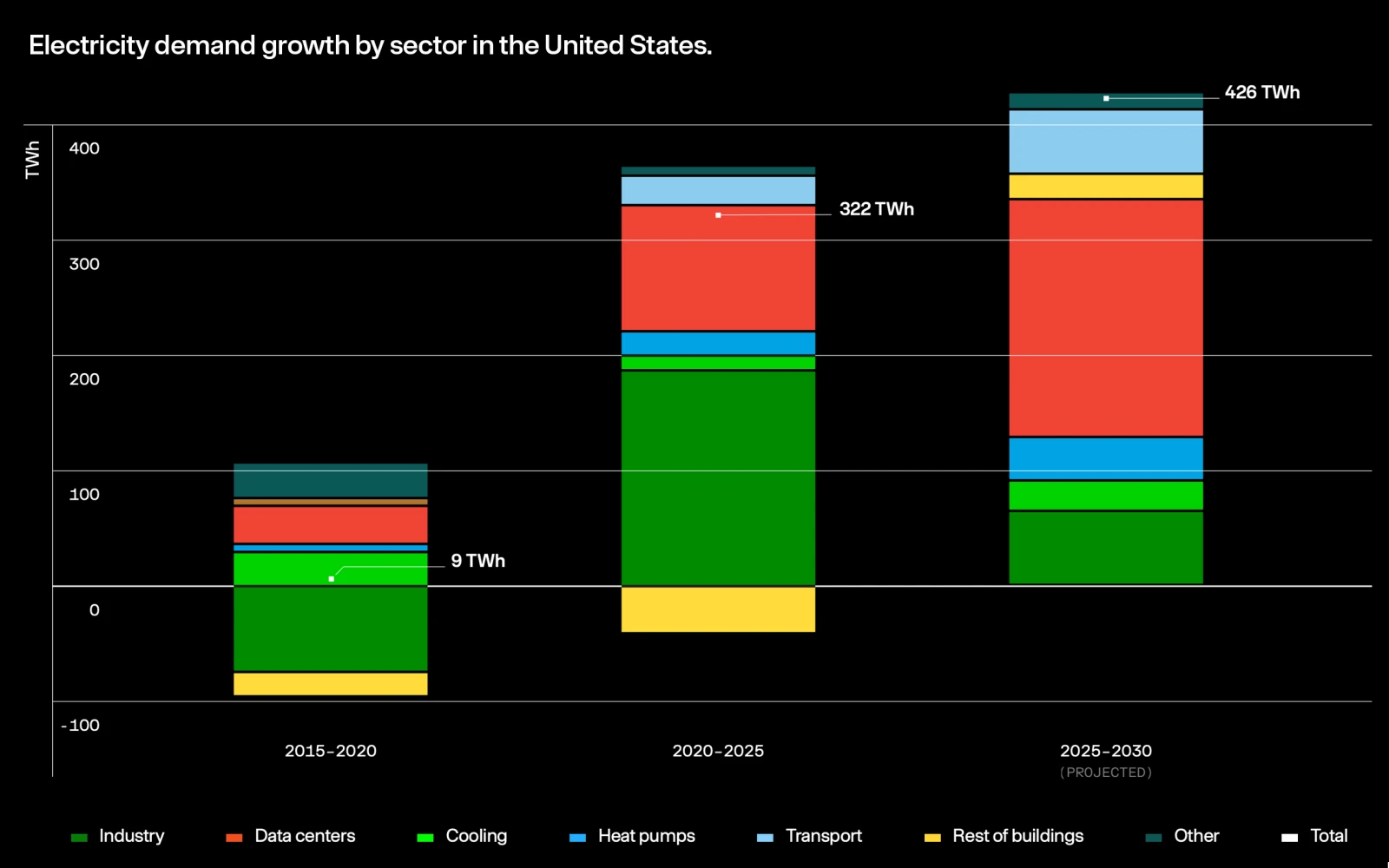
Hyperscale computing and AI, plus the electrification of industry and transportation, are driving unsustainable competition for energy.
Power, water, land, permitting, and capital constraints add months or years to construction projects and make it difficult to scale domestic production quickly when needed.
Natural sources of fresh water are being exhausted.
Regional water shortages — intensified by climate volatility — affect industry, agriculture, and cities.
The physical infrastructure is aging and brittle.
Power grids, water systems, and transportation networks in the United States and many other developed nations were built for a different era, and are vulnerable to cascading systems-level failures and external attacks.
Supply chains for critical minerals and materials are fragile.
Markets are opaque and overly concentrated; geopolitical rivals control key inputs for semiconductors, batteries, vehicles, and other products.
Runaway costs in healthcare, medicine, and insurance are inflicting enormous pain on households.
This is especially true in the United States and other nations with aging populations and a high chronic disease burden.
Labor shortages in skilled technical and industrial roles limit U.S. competitiveness.
We aren’t grappling with AI- or robotics-induced mass unemployment (yet), but with its opposite.
Climate instability is generating more frequent and more costly disasters.
Storms, floods, heat waves, and wildfires are magnifying infrastructure repair costs and insurance losses.
The geopolitical picture remains unsettled.
The United States faces global and regional adversaries who are experimenting with new forms of warfare, including autonomous and attritable systems and influence operations.
To compress the point: The risks and uncertainties that have always made planning a challenge are only growing today as powerful technologies collide with physical and institutional limits. For example, if supplies of AI chips keep growing at current rates, the electricity required to operate and cool those chips will exceed the power capacity of the entire state of California by 2028, according to RAND. Trajectories like this are obviously untenable. Exponentially improving technological capabilities cannot be allowed to translate into exponentially increasing energy requirements, costs, material demands, and project timelines — if they do, the industrial economy will collapse under its own weight.
But the way we see things here at DCVC, there’s still one critical lever that can help bend escalating cost and schedule curves downward, begin to restore predictability, and, as we like to say around here, “cancel the apocalypse.”
That lever is fundamental deep tech innovation.
Our quest as investors — as we’ve explained in previous editions of this report — is to find companies using computation to engineer solutions to trillion-dollar problems that older technologies haven’t fixed. But not just any solutions. The ideas that interest us most have three special qualities:
Most importantly, we look for innovations that pay for themselves rather than adding to ever-rising costs. This means they don’t require permanent subsidies; they don’t shift costs elsewhere in the system; and they don’t look good at pilot scale only to grow unaffordable as they scale up. They reduce the need for blind experimentation through sensing, simulation, and prediction. They’re built around computation and rapid learning curves that make physical processes faster with iteration, so their unit economics improve with deployment. And the gains they achieve are measurable, defensible, and compounding.
For an example, look at advanced geothermal company Fervo Energy, which we’ve backed since 2022, and which raised $2.2 billion in an initial public offering on the Nasdaq exchange this spring. By applying cutting-edge drilling techniques from the oil and gas industry, real-time downhole sensor data relayed by fiber optic cables, and hands-on experience in the field, Fervo has been able to dramatically lower the time and cost required to drill new wells. By 2028 the company expects to have 500 megawatts of firm clean power on the grid — as much as a typical combined-cycle natural gas power plant — and over time its plan is to outcompete natural gas on a costper-megawatt basis.
Or look at Relation Therapeutics, a TechBio standout where we first invested in 2021. The company’s “lab-in-the-loop” approach lowers the cost of drug development by shaving months to years off the usual discovery timelines for new drugs. Relation collects enormous amounts of gene and protein data from healthy and diseased human tissues; trains AI models on that data so they’ll recognize the genes and proteins most likely to be involved in disease; uses predictions from those models to modify cells for the next round of experiments; and so on, until it identifies wholly new molecular targets for interrupting disease processes and molecules that can act on them. Pharma giant GSK, among others, has validated Relation’s approach through partnership agreements worth tens of millions of dollars in upfront cash and billions of dollars in milestone-based payments.
As we search for ideas that will help retool old industries and give rise to new ones, we also focus on those that will be relatively invariant to political and regulatory change. To be venture-investable, in our view, a new technology needs a regulation- and ideology-agnostic value proposition that will survive each successive administration. When technologies win on economics first, adoption can be driven by lower cost, higher reliability, and better performance, not mandates or subsidies.
Consider Mainspring Energy, which builds innovative flex-fuel linear generators that can be placed on-site near factories or data centers to provide primary or backup power, which replaces dirty, expensive, inflexible diesel generators. Advanced power electronics let these parking-space-sized generators switch between natural gas, propane, biogas, hydrogen, or ammonia with no modification while compensating automatically for different energy densities. They can be deployed under existing permitting standards, without grand infrastructure overhauls — Prologis, for example, turned to Mainspring to power EV chargers for electric trucks at its Los Angeles and Long Beach port facilities, completing the installation in just nine months. With wait times for new grid connections stretching to five to eight years, it’ll take exactly this kind of innovation in behind-the-meter power sources to support the “electrification of everything” we highlighted in our 2023 report and the swift reshoring of manufacturing we talked about last year.
Similar logic applies to Radiant Industries, which makes 1‑megawatt advanced nuclear fission reactors perfect for powering military bases, replacing backup diesel generators, and powering off-grid communities. In 2026 the company expects to reach the landmark achievement of ‘turning on’ the United States’ first-ever advanced fission nuclear reactor, and by 2034, Radiant expects to have up to 50 reactors in the field. Energy resilience like this matters under any geopolitical scenario. It doesn’t presuppose consensus across party lines; it strengthens domestic capacity; and it provides direct benefits to manufacturers and municipalities, creating local champions.
A third quality that unites almost all the companies we back is that they use advanced forms of computation, especially machine learning, to make natural or mechanical systems more programmable and engineerable and, as a result, more efficient.
Consider Sabanto, AgZen, and Verdant, three agtech companies backed by DCVC Bio. They’re all confronting the reality that farming still involves enormous amounts of waste, whether of human labor time or chemical inputs like fertilizer and pesticides. Sabanto builds kits farmers can use to make their existing tractors self-driving. Verdant and AgZen make sensing systems that can adjust spray output for weather conditions and deliver pesticides more precisely, down to the level of individual weeds. In complementary ways, these companies are using imaging, AI, and robotics to make farms behave more like computational systems — so that farmers can tend their fields with fewer people and spend less money on crop protection.
Identifying and supporting the entrepreneurs and companies that best embody these three qualities is our job. The story plays out differently across our areas of specialization — computing, energy, water, healthcare, drug discovery, agriculture, space, and defense.
And different elements move to the foreground as market conditions evolve. But DCVC’s fundamental premise hasn’t changed since our founding in 2010. We see advanced computing as a universal solvent that allows the ingredients of innovation to mix — lowering the cost and risk of experimentation, revealing ground truths faster, smoothing out costly technical wrinkles, and making chaotic systems more predictable and engineerable.
Each year the Deep Tech Opportunities Report gives us the chance to describe what new bets we’re placing, how old bets are paying off, and how we’re adapting our thinking in each investing area. Here are a few of the high-level trends you’ll notice in the report; many of our investments respond directly to these realities.
- In classical computing, there’s an urgent need for fundamental improvements in speed and efficiency at all levels, from chips to data centers to machine learning architectures to physical AI.
- In quantum computing, we are at the edge of perfecting new hardware modalities, error correction mechanisms, and sensing technologies that will make massive computational gains a reality for business and industry.
- In the energy system, deep tech can provide a way out of the dilemma posed by exponentially rising power demand; aging, outdated physical infrastructure; and an increasingly volatile climate.
- In energy and climate tech, advances in classic deep tech disciplines such as power electronics or subsurface drilling techniques can help us get structural risks under control and improve the resilience of communities and industries.
- In industry, we can achieve our reindustrialization, reshoring, and decarbonization goals if we find ways to rationalize logistics, build smarter factories, make low-carbon steel, cement, and fuels, and secure predictable, sovereign supplies of water and critical minerals.
- In the life sciences and agriculture, we can speed up drug discovery, lower failure rates, reduce healthcare costs, cure more human diseases, and make food systems healthier and more efficient by introducing bigger and better computational models, trained on more high-quality data.
- In defense, deep tech innovators can deploy new forms of autonomy to transform the battlefield and deploy countermeasures against hostile actors.
If there’s a master trend here, it’s that better technology reduces risk and uncertainty and makes the world a more predictable place. And we believe the best place to look for fixes and improvements is deep inside a system rather than on its surface. Not just better software but more efficient chips. Not just greener hydrocarbon fuels but carbon-neutral, drop-in replacements for those fuels. Not just clean, renewable energy but energy that’s so cheap that businesses must switch away from hydrocarbons out of economic self-interest. Not just more drugs but drugs that are safer in a predictable way and developed at far lower cost and in less time. Those are the kinds of ideas venture-backed, computation-first deep tech companies can uniquely explore and exploit. We hope you’ll enjoy this year’s look at how our portfolio companies are doing this, and how we see them driving the evolution of their industries in the near future.