We know that we can manufacture qubits using multiple modalities, and we know that we can make them reliable using practical, low-overhead quantum error correction. In other words, the path to full fault-tolerant quantum computing is now clearer than ever. But can we create value even before we get there? Again, the answer is yes. The first scalable market will be quantum-enhanced sensing and measurement.
The Global Positioning System is an orbital metronome providing timing information that underpins modern travel, logistics, finance, telecom, and defense. It’s a magnificent achievement, but it’s not perfect. Outside of specialized applications such as surveying, its accuracy is limited to about 30 centimeters. GPS signals degrade at the extreme latitudes of the Arctic and Antarctic because satellite inclination is optimized for mid-latitudes. And signals can be unintentionally degraded by natural phenomena such as solar flares, or intentionally jammed or faked in active conflict zones and contested shipping lanes, such as those in the Middle East.
But today, an alternative is emerging: quantum-assured positioning, navigation, and timing (PNT) powered by quantum sensors and advanced software. One of the leaders in this technology is Q‑CTRL, where we first invested in 2018. The company got its start in the field of quantum error suppression — not purely mathematical error correction in the style of Iceberg Quantum, but software that pinpoints environmental noise causing decoherence and optimizes control pulses to counteract it. Along the way, Q‑CTRL got so good at stabilizing quantum systems against noise and other disturbances that it realized it could build its own hardware powered by quantum control.
One of the things that can disturb a quantum system is a tiny shift in position or velocity. Treat that vulnerability as an asset, and suddenly you’ve got a quantum sensor that can detect very weak acceleration — and the core of a new kind of wayfinder. Together with Lockheed Martin, Q‑CTRL has a contract with the U.S. Department of Defense Innovation Unit to build quantum inertial navigation systems that are immune to jamming and spoofing and will help warfighters determine their position, speed, and orientation even in GPS-denied environments.
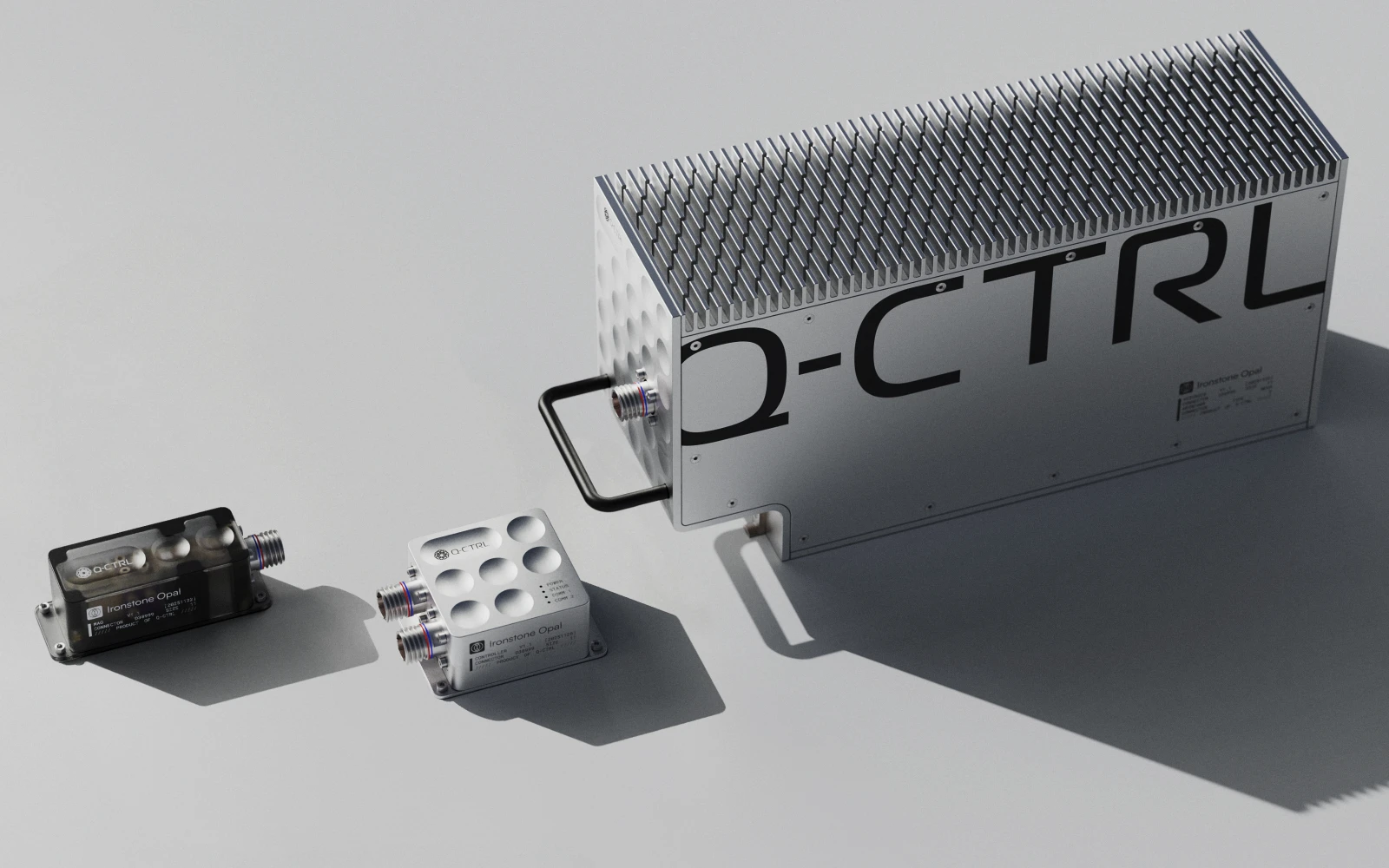
Separately, Q‑CTRL built a navigation system called Ironstone Opal that senses tiny changes in magnetic and gravitational fields, as well as acceleration. When data from Ironstone Opal’s sensors is matched against fine-grained geomagnetic and gravimetric maps of the Earth, it’s possible to dramatically reduce positioning error compared to standalone GPS. (In a 700-kilometer flight in Australia last year, the Q‑CTRL system showed 111 times greater positioning accuracy than a high-end legacy GPS device.) Time Magazine named Ironstone Opal one of the best inventions of 2025, and the company is working with Airbus to test it on large aircraft. Q‑CTRL’s progress suggests that quantum precision, once confined to laboratories, can now be engineered into field-deployable systems — and sold.
GPS-denied environments are everyone’s fear in current conflicts. So you want navigation equipment that is resilient to electronic warfare — but the last thing you want is for everything to get heavier and heavier. [With Mesa Quantum] we can reduce the SWaP of these platforms and fly many more of them, and fly them cheaper.”
Dr. Prineha Narang
Operating Partner, DCVC
Quantum sensing doesn’t require thousands of qubits or full logical stacks. It monetizes quantum decoherence directly — through defense and aerospace budgets first, and then the larger civilian market. In fact, it’s an industry complete with an emerging supply chain. Mesa Quantum, where we invested in 2025, makes a specialized type of component for quantum sensors called vapor cells. They’re small glass containers filled with clouds of vaporized alkaline metal atoms, whose absorption of laser light changes if their internal quantum states are shifted by magnetic fields, acceleration, or other disturbances. They enable magnetometers, gravimeters, accelerometers, gyroscopes, and atomic clocks with exceptionally low SWaP — size, weight, and power.
“In this case, low-SWaP means poker-chip-size or blueberry-size,” Narang says. “You can imagine many of these sensors on drones or your favorite flying platform. So we’re very excited about this investment in Mesa Quantum.”