Transporting diesel fuel to remote locations is difficult and expensive. And yet there are hundreds of communities and settlements in the United States — primarily in Alaska — that are so far off the grid that they’re forced to depend almost entirely on diesel generators, at a cost-per-kilowatt-hour that’s much higher than the national average. In the winter months, cold, darkness, and harsh arctic weather conditions make fuel delivery especially unreliable. Numerous Defense Department forward- and remote-operating bases face similar challenges, with added risk for the military personnel who deliver the fuel.
Small factory-built fission reactors are an intriguing alternative. They provide firm, continuous electricity; they are virtually drag-and-drop, requiring minimal on-site setup; and the optimal designs operate for years without refueling.
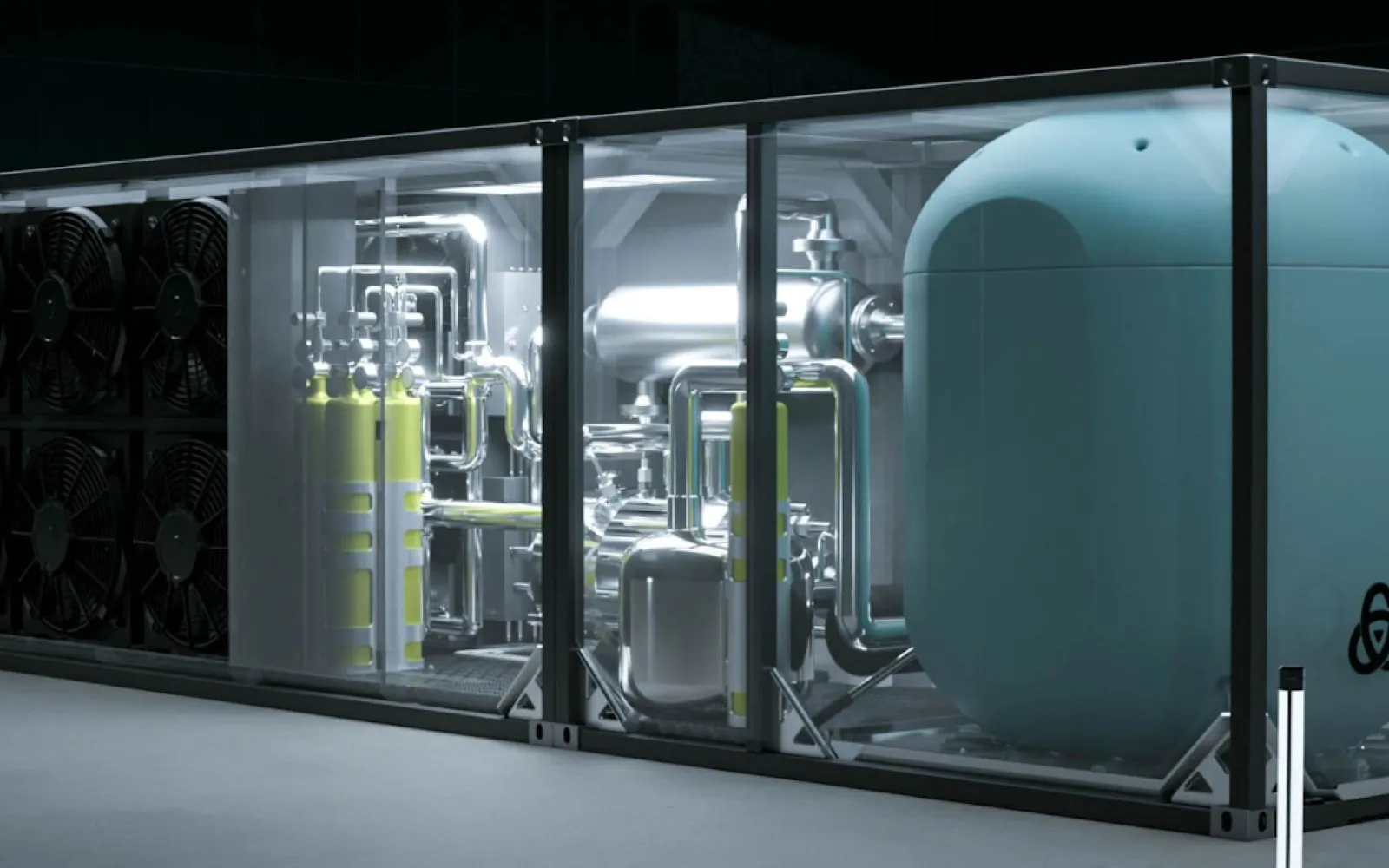
In 2022 we invested in Radiant Industries, a company in El Segundo, Calif., building a 1‑megawatt microreactor called Kaleidos that’s scheduled to undergo its first fueled test this summer. The technology is wholly unlike the utility-scale reactors familiar since the 1950s, with their giant containment structures, elaborate water-based cooling systems, and tall cooling towers. The entire Kaleidos system — reactor core, heat exchanger, generators, electronics, and all — fits inside a semitrailer. Inside the core are kernels of uranium, carbon, and oxygen encased in layers of carbon and ceramic — a durable, robust combination known as TRISO (TRI-structural ISO-tropic particle). Helium gas carries heat from the reactor to the power generation loop, and an air-cooling system ejects the heat to the atmosphere, with no water required.
Kaleidos’ small footprint makes it deliverable to any location by road, rail, or air. Its sealed, self-contained architecture and passive safety systems mean it needs minimal operations or support staff. The reactor has a 20-year lifetime and only needs to be refueled every three to five years. And modeling suggests that microreactors can be cheaper than diesel generators in locations where delivered fuel prices exceed $1.50 per liter, about $5.70 per gallon. The conflict in Iran has already driven U.S. average pump prices above that level in some states. And transport logistics and structural dynamics in some regions drive prices much higher. That’s when alternatives like microreactors make economic sense.
We admire Radiant in part because they’re so focused on execution. “For the last five years, since I started working with the company, they’ve been planning to turn on their demonstration reactor in 2026, and they’ve stayed on schedule and on budget,” says DCVC General Partner Dr. Rachel Slaybaugh, who leads DCVC’s nuclear investments and created the nuclear fission program for the DOE’s ARPA‑E. Radiant will be the first company to test their reactor inside the Idaho National Laboratory’s DOME facility — where they can take advantage of the lab’s infrastructure — as well as the first advanced reactor to do a full power demonstration.
Also this year, Radiant will break ground on a factory in Oak Ridge, Tenn., where it plans to build as many as 50 reactors per year. Takers will include the Pentagon’s Defense Innovation Unit and the Air Force, which have signed a deal to buy microreactors for military bases. Equinix, the world’s largest operator of data centers and colocation centers, has put down a deposit on 20 reactors.
Interest in nuclear power is spiking in the wake of executive actions that created the DOE’s Reactor Pilot Program, a streamlined process for testing and early commercial deployment. Ten companies have been selected for the pilot program, including Radiant and DCVC-backed Oklo (see sidebar). As regulatory timelines compress and capital flows into the sector, Slaybaugh emphasizes the importance of rigorous engineering and governance. “There are a few serious companies, and there’s a cacophony of other people in the space that are not as responsible,” Slaybaugh says. Radiant’s board includes former Nuclear Regulatory Commission leadership, and the company has engaged experienced external reviewers to scrutinize its design and safety case. In an industry where credibility matters as much as innovation, that preparation may prove decisive.
Diesel generators aren’t just sources of carbon and particulates — they make energy supply into a recurring logistics problem. A sealed microreactor provides multi-year predictability in locations the grid hasn’t yet reached or will never reach. We see advanced, small-scale fission as part of the larger shift to a less volatile, more resilient energy infrastructure.