The first generation of quantum startups tried to win mostly by building better qubits. The next generation — the group of companies we’ve already been talking about — is building systems designed from the outset to support scalable error correction, and that’s what will finally make qubits usable in the fault-tolerant quantum computers of the near future.
To review: physical qubits are the finicky objects that hold a 1 and a 0 in superposition inside a quantum computer. Logical qubits are error-corrected qubits where quantum information is encoded across many entangled physical qubits and continuously stabilized through measurement. When the fidelity of physical qubits was low, and when error detection and correction codes were relatively primitive, it could take thousands — sometimes tens of thousands — of physical qubits to make just one reliable logical qubit. For two decades, then, the bottleneck to fault-tolerant quantum computing was whether we could even make decent physical qubits.
And today we’re getting there: as we explained in the previous section, physical qubits are gaining fidelity and becoming more manufacturable, to the point that some amount of redundancy is affordable. But the big question is how much redundancy is needed, and how that redundancy is organized: will a fault-tolerant quantum computer require millions of physical qubits, or merely hundreds of thousands? And that’s where better error-correcting schemes enter the picture. If physical qubits are good enough — below the error threshold required by a given scheme — then increasing the number of physical qubits participating in that scheme causes logical error rates to fall exponentially. But not all schemes use redundancy equally efficiently; the decisive question is how much reliability you get per additional qubit.
Error correction schemes called “surface codes” were the first practical bridge from fragile qubits to scalable machines. They arrange physical qubits in a 2D grid (a surface) and assume that each qubit interacts only with its nearest neighbors. Quantum information is stored in data qubits, and neighboring ancillary qubits detect errors by repeatedly measuring parity relationships (seeing whether pairs of qubits agree or disagree, without revealing their individual states). This scheme is conceptually simple and it matches real hardware layouts, but it is qubit-hungry: making the quantum circuit more reliable requires widening the grid, and the number of physical qubits grows with the square of that width.
Thanks to recent advances, there’s a more economical alternative: Quantum Low-Density Parity Check codes, or QLDPC, inspired by classic LDPC codes used in wireless communications protocols like Wi-Fi and 5G. In these schemes, parity checks occur across a sparse, cleverly connected graph. Logical errors can be suppressed without requiring a 2D grid of physical qubits that balloons in area. Whereas surface codes were designed for hardware with fragile qubits and limited connectivity, QLDPC codes assume fabrication improvements and higher connectivity, and use advances in sparse graph design to extract more logical protection per physical qubit.
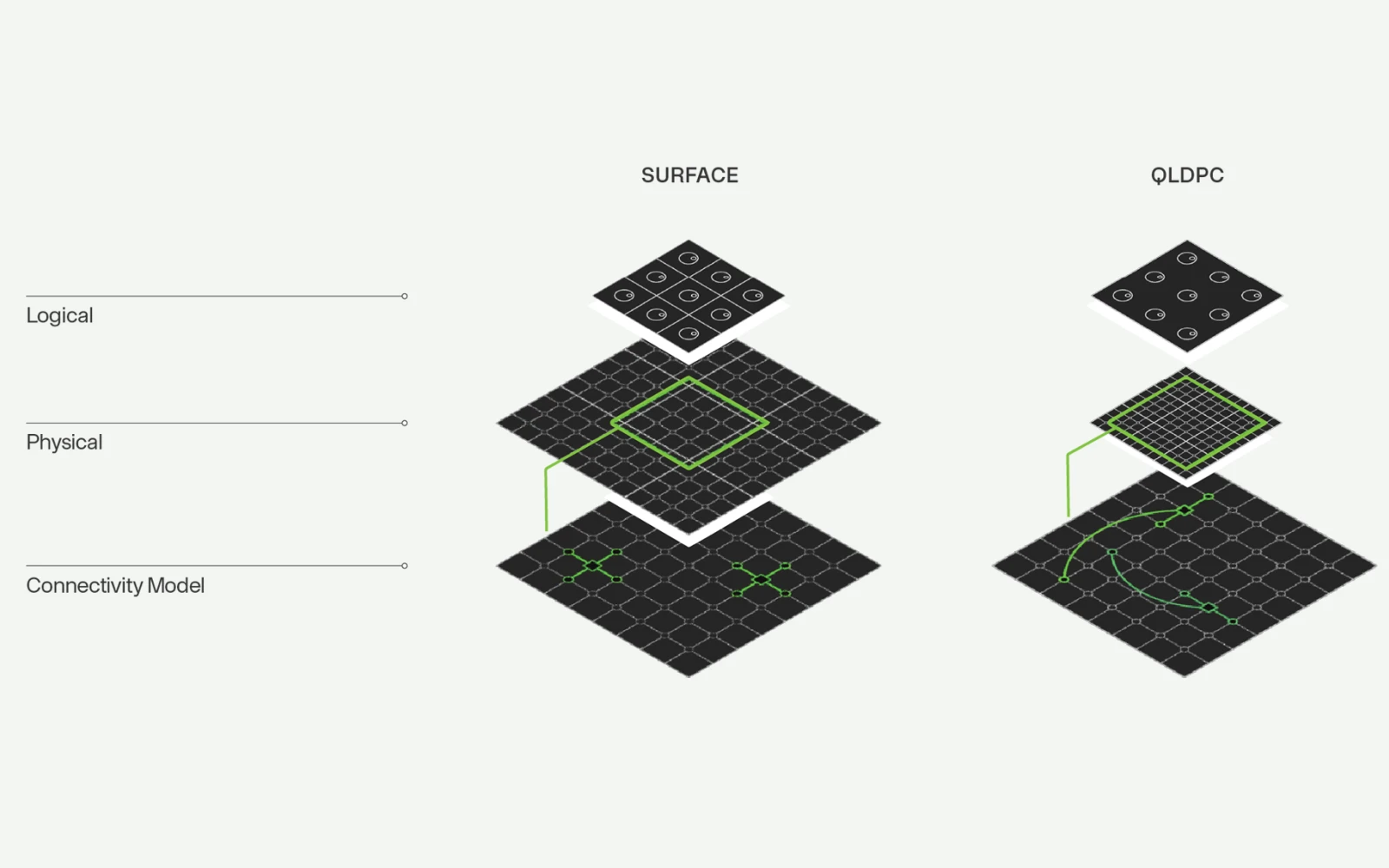
That may sound like an incremental shift, but it could determine whether the field becomes economically viable within a venture time horizon. “With surface codes, the overhead of physical to logical qubits was always 100 to 1, or 1,000 to 1, or even higher, and now it’s coming down to single-digits-to‑1,” says DCVC’s Narang. “Of course, the devil is always in the details. But there’s a lot the field has been able to accomplish, which makes companies focused entirely on quantum architecture and error correction valuable to us.”
Recently we invested in Iceberg Quantum, an Australian company creating state-of-the-art QLDPC codes that are already accelerating the work of quantum hardware companies such as Diraq (silicon spin qubits), IonQ (trapped-ion qubits), and PsiQuantum (photonic qubits).
Narang calls Iceberg Quantum “the ARM of quantum computing” — a company that doesn’t build the hardware itself, but provides the architectural layer that multiple hardware vendors can then adapt. Iceberg’s work “gives you a blueprint of which qubit you’re going to move, which you’re going to keep stationary, what pairs you’re going to address,” she explains. “It’s like putting together a seating chart for a wedding that takes into account everyone’s social proclivities — but where the constraints are what your qubits are capable of doing and what number of operations you can accomplish before decoherence.”
In early 2026 the company published a paper showing that, in theory, a quantum computer using its new Pinnacle QLDPC architecture could factor a 2048-bit RSA key — the backbone of much of today’s public-key cryptography — using just 100,000 physical qubits, compared to the 1 million or more researchers thought would be required using surface codes. That finding is a warning about the vulnerability of classical cryptography schemes. But even more, it’s a signal that the physical scale required for fault-tolerant quantum computing may be compressing far faster than expected.
[The Iceberg architecture] is like putting together a seating chart for a wedding that takes into account everyone’s social proclivities — but where the constraints are what your qubits are capable of doing and what number of operations you can accomplish before decoherence.”
Dr. Prineha Narang
Operating Partner, DCVC